
A $10 stake gives an expected loss of $0.30 in Aviator. The game’s RTP is 97%, so its house edge is 3% over a large number of bets. That result does not mean every $10 bet loses $0.30. One round can pay much more, return the stake with a small profit, or crash at 1.00x.
The central formula is simple: the probability that a round reaches multiplier m is 0.97 divided by m. At 2x, the probability is 0.97 / 2, or 48.5%. At 10x, it is 9.7%. This article examines that formula, instant crashes, expected value, and the high variance created by different cash-out targets.
Aviator RTP and Edge
Aviator has an RTP of 97%. Spribe describes Aviator as a crash game in which an increasing curve can crash at any time.
RTP means return to player. A 97% RTP means that the mathematical return is $97 for every $100 staked across a large sample. The remaining $3 is the house edge. The edge belongs to the game, not to a particular cash-out button or betting pattern.
- RTP: 97%
- House edge: 3%
- Expected value: -3% of the stake
- Game type: crash game and instant game
A $1 stake has an expected loss of $0.03. A $20 stake has an expected loss of $0.60. A $100 stake has an expected loss of $3. These are averages from the mathematical model. They are not fixed results for individual rounds.
The same edge applies when the target is 1.2x, 2x, or 10x. A low target may produce more frequent small wins. A high target may produce fewer larger wins. Neither target removes the 3% edge.
Aviator displays different multipliers on a phone and a laptop.
Spribe launched Aviator in early 2019, with the first live launch on Adjarabet in February 2019. The mathematical point remains separate from the interface: the displayed multiplier rises, but the RTP stays at 97%.
Probability at Each Multiplier
Aviator uses the probability formula 0.97/m. A 1.2x target has an 80.8% chance of being reached.
The formula uses the target multiplier as m. Divide 0.97 by that target, then convert the result into a percentage. The table uses the probabilities supplied for common targets.
| Target multiplier | Calculation | Probability of reaching target |
|---|---|---|
| 1.2x | 0.97 / 1.2 | 80.8% |
| 1.5x | 0.97 / 1.5 | 64.7% |
| 2x | 0.97 / 2 | 48.5% |
| 3x | 0.97 / 3 | 32.3% |
| 5x | 0.97 / 5 | 19.4% |
| 10x | 0.97 / 10 | 9.7% |
| 20x | 0.97 / 20 | 4.85% |
| 50x | 0.97 / 50 | 1.94% |
| 100x | 0.97 / 100 | 0.97% |
At 1.5x, the table gives a 64.7% chance of reaching the target. At 5x, the chance falls to 19.4%. At 100x, it falls to 0.97%. The multiplier grows faster than the probability of reaching it.
- 1.2x is reached in about 80.8% of rounds.
- 2x is reached in about 48.5% of rounds.
- 5x is reached in about 19.4% of rounds.
- 10x is reached in about 9.7% of rounds.
- 100x is reached in about 0.97% of rounds.
These percentages describe each target before a player chooses to cash out. They do not predict the next round. A previous 10x result does not make 2x more or less likely in the following round.
A cash-out at 2x returns twice the stake when it succeeds. A cash-out at 10x returns ten times the stake when it succeeds. The lower success frequency at 10x offsets the larger payout under the 97% RTP model.
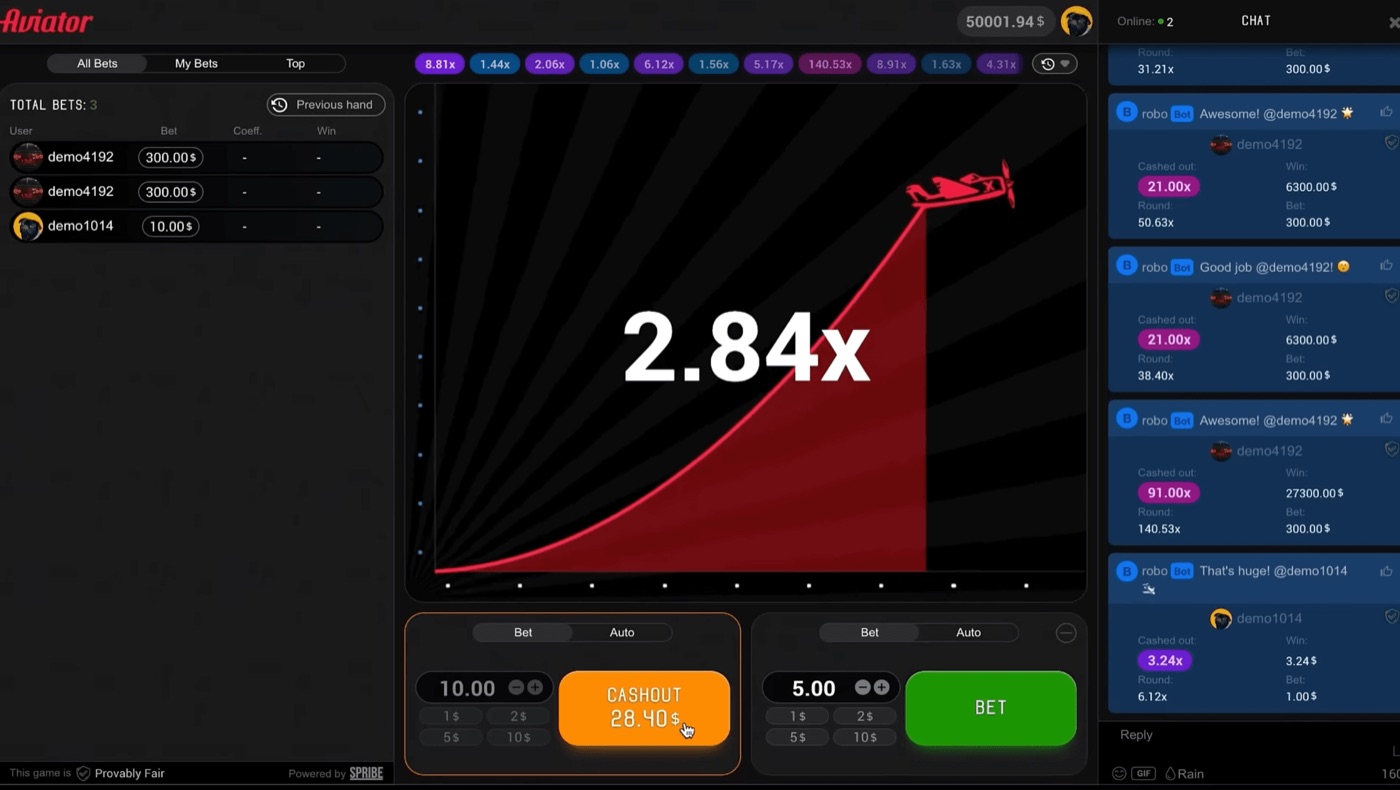
The Aviator interface shows live bets, chat and a 28.40x cash-out.
Instant Crashes and Timing
Aviator rounds last about 8 to 30 seconds. About 3% of rounds crash instantly at 1.00x, or roughly 1 round in 33.
An instant crash gives a player no time to cash out. It is part of the probability distribution behind the 97% RTP. The 0.97 in the formula reflects the game’s return factor, while the instant-crash result shows why a round can end before a low target is reached.
- A round can end at 1.00x.
- An instant crash affects every active bet in that round.
- About 3% of rounds have this instant result.
- The approximate frequency is 1 in 33 rounds.
Aviator runs at about 60 to 90 rounds per hour, with a few seconds between rounds. More rounds create more betting opportunities, but they do not improve the probability of any individual target.
For example, a player may see several low multipliers during a short session. That sequence does not create a mathematical obligation for a high multiplier. Rounds are independent. Graph analysis, pattern claims, “best time to play” claims, and strategy chart PDFs do not change the stated odds.
The game fixes the crash point before take-off. Before each round, the server publishes a SHA-256 hash of the server seed. Client seeds from players are combined with it, and the inputs are revealed after the round so the result can be checked with the verification tool inside the game.
Expected Value Per Bet
Aviator gives every cash-out target an expected value of -3% of the stake. A $50 bet therefore has an expected value of -$1.50.
Expected value, or EV, combines possible outcomes with their probabilities. It does not describe the result of one round. It describes the average result that the model approaches across repeated comparable bets.
Consider a $10 stake with a 2x cash-out target. The target has a 48.5% probability of being reached. A successful cash-out produces a $10 profit before considering the stake return, while a failed bet loses $10. The weighted result is approximately -$0.30, matching the 3% house edge.
Consider the same $10 stake with a 10x target. The target has a 9.7% probability of being reached. A successful result produces a $90 profit before the original stake is considered in the net accounting, while a failed bet loses $10. The weighted result is again approximately -$0.30.
That is the key comparison:
- 2x wins happen more often than 10x wins.
- 10x wins pay more than 2x wins.
- The mathematical EV remains -3% of the stake.
- The target changes the result pattern, not the house edge.
For players comparing the math before placing a stake, the [aviator bet download] sentence should not be treated as evidence that any tool can change an RTP, multiplier, or cash-out result. No calculator can turn a negative EV into a positive one when the underlying probabilities remain the same.
Operators may set different stake amounts and win caps. Typical stakes range from about $0.10 to $100 per bet, depending on the operator. Those settings change the cash amount at risk, not the 97% RTP stated for the game.
Variance and Betting Plans
Aviator is a high-variance game. A 1.5x target and a 50x target produce very different result patterns even though both retain the 3% edge.
Variance measures how widely results can move around the expected average. A low target can produce frequent small wins and frequent small losses. A high target can produce long losing sequences followed by a large win. Neither pattern changes the negative expected value.
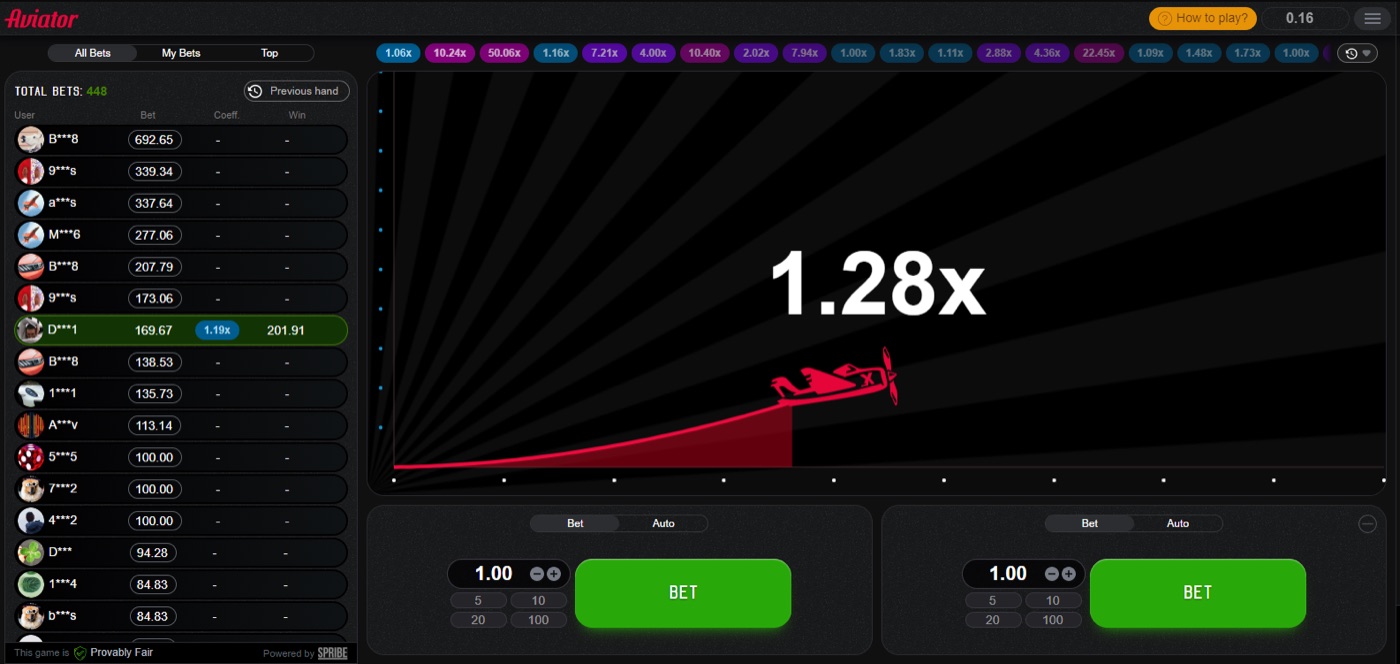
The plane rises during an Aviator round before the crash point.
Some guides describe a two-bet split. One bet uses a cash-out around 1.5x to 2x, while the other stays open toward 5x to 10x. This changes the timing and size of wins. It does not change the EV of the stakes.
- Auto Cash-Out can use a preset multiplier.
- Two bet panels can use separate cash-outs.
- Auto Bet or Auto Play can run for 10 to 100 rounds.
- Stop-on-win and stop-on-loss settings can end an automated sequence.
Martingale is a different example. The method doubles the stake after each loss. After 10 losses, the stake reaches 1,024 times the base stake. Fibonacci and D’Alembert systems also do not beat the 3% edge.
A modest risk plan can limit exposure without changing the game’s math. Guides commonly mention staking no more than 2% of a bankroll per round, setting loss and win limits, and starting in demo mode. A player should stop when gambling stops fitting a chosen limit.
Fairness and Cash-Outs
Spribe’s provably fair system publishes a server-seed hash before each round. The crash point is fixed before take-off, and neither Spribe nor the operator can change the result after the round starts.
Cash-out requests still depend on reaching the server before the crash. A time-out can result from latency or a slow device, so the request may arrive after the fixed crash point.
- The server publishes a SHA-256 hash before the round.
- Player client seeds are combined with the server seed.
- The inputs become visible after the round.
- The game includes a verification tool.
- The cash-out request must reach the server before the crash.
The interface includes a Provably Fair badge, round history, live bets, chat, and two betting panels. These features display activity and settings. They do not provide a way to predict the next crash point.
There is no standalone official Aviator app from Spribe. Aviator runs inside an operator’s website or app, while apps named “Aviator” or “Aviator Predictor” on app stores and APK mirrors are third-party clones with virtual-coin or advertising disclaimers.
Aviator FAQ
Aviator has a 97% RTP and a 3% house edge. The 0.97/m formula gives the probability that a selected multiplier is reached.
Instant crashes, expected value, and variance explain why a frequent low target and a rare high target can have the same mathematical edge.
What is Aviator’s RTP?
Aviator’s RTP is 97%. Its house edge is 3%, which gives an expected value of -3% of the stake at every cash-out target.
What does 0.97/m mean?
The formula gives the probability that a round reaches multiplier m. For example, 0.97 / 2 equals 48.5%, while 0.97 / 10 equals 9.7%.
How often does Aviator crash instantly?
About 3% of rounds crash instantly at 1.00x. That is roughly 1 in 33 rounds.
Can a strategy remove the house edge?
No. Auto cash-out, split bets, Martingale, Fibonacci, D’Alembert, and other staking choices can change variance and bet timing, but they do not remove the 3% edge.
Can an app predict Aviator?
No. The crash point is committed by hash before the round begins. Predictor apps and Telegram signal bots cannot predict it or alter the 0.97/m probabilities.
Why can a cash-out time out?
The cash-out request must reach the server before the crash. Latency or a slow device can delay the request until after the fixed crash point.